domenica, febbraio 11, 2007 

Il colosseo e Il colosso di Nerone

We spoke once of legends about the Colosseum. Here is another story. So, legends tells that the name of this monument derives from a colossus of Nero, a statue, that was very high and big; infact when Vespasiano (the emperor who built the Colosseum) changed the head of it, because of the hate of roman people against Nero, he had to make a very expensive and hard job. Infact he wanted to replace Nero with Apollus, the god of the sun; in particular behind the head of it, there were 7 ray of light, that to respect the proportion were of 21 feet. But this statue was also wrapped by a mystical and magic attention: infact a legend tells us that this statue was possessed by one of the most terrifying demons, imprisoned by priests. These priests, when a devout was in front of the colossum, asked him: "Colis eum?" (do you adore him?) (someone says that the name derives from it Colis eum -> colisseum) ; whatever was the response, the fortune of the devout was different. The power of this idol was so big that the he was able to blow a freezing wind or a hot one, and moreover, during the day it was able to follow the rotation of the sun. Among devouts of it, there was Rossana, the wife of a roman king called Austerio, in the period when Roban was emperor (still today, no one is able to say who was Rabon). Anyway, Rossana wanted a son, but after a lot of years she was still barren; so one day she went to the statue to ask a son. The scary voice of it, said that she had to give a lot of jewels and money as sacrifice to the differents gods of Rome and in 9 months she will have a son, who will be called Olimpiodoro. But even if she did it, she wasn't pregnant after a whole year. When she felt totally desperate, she saw christians going to death, with a smile on their faces, and she was surprised seeign it and so a night she said with her heart out "Mary of Christians, let me have a baby!". She was surprised by her same words, but after nine months she birthed a baby, who was called Sebastiano, like the martyr. For more information post me a comment or e-mail me. Dblk

Etichette: , ,

martedì, novembre 07, 2006 

Le oche del Campidoglio

Today I'm gonna tell you the most famous legend of Rome, the legend of Campidoglio's (Rome townhall) gooses. We are in the 390 b.C. and Rome was besieged from a barbaric army led by Brenno. They have already surrounded the Campidoglio and they were looking for a passage to enter the palace in which there were the last romans (the others went to Vejo and Caere when the enemies were close to the city). The only hope for Rome was the leader Marco Furio Camillo, but he was exiled in Ardea for his political positions and it was difficult to contact him; anyway a man was able to reach him, but when he came back to Rome, enemies saw him accessing the Campidoglio from a secret passage. So, they were going to enter the city when the gooses of the temple of Juno (a divinity, the wife of Zeus) started to make a lot of noises; it's important to remark that they were the last group of animals (the others were dead because of the siege) because they were consecrated to Juno and she was a protector of Rome. Because of these noises Marco Manlio, an ex consul, noticed the army and he called out his troups expelling them. Meanwhile Furio Camillo was reaching Rome with his army and the barbaric army was loosing a lot of battles; so Brenno, cleverly, said that his army was ready to leave Rome if the city would give them 1000 pounds of gold. Romans decided to pay, but when they were ready to give the gold, they noticed that the balance was set wrongly (enemies wanted to cheated them); so they protested, but Brenno, put his iron sword on the balance demanding a bigger weight of gold and said: "Vae Victis" (Losers must be careful). But while romans were looking for the other gold, Furio Camillo reached Rome with his army and keeping his sword in his hand in front of Brenno, said: "Non auro sed ferro, recuperanda est patria" (Not with the gold, but with the iron, we can redeem our country). So with his army he fighted off Brenno. Fro more informations post me. Dblk

lunedì, ottobre 02, 2006 

San Giovanni in Laterano

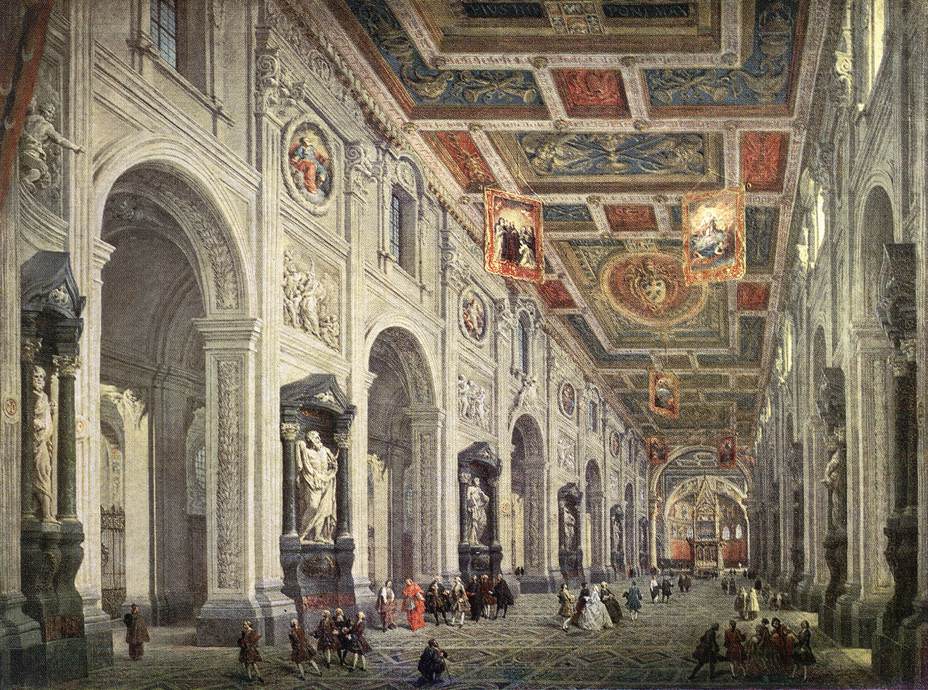
Today we'll talk about one of the most famous churches of Rome. The basilica of S. Giovanni in Laterano (S. John Lateran). There are a lot of mysteries that are all around this holy palace; in effect the Lateran was the most acient residence of the Pope and it's easy to understan how a lot of legends are born from this palace, in a time in which this was the centre of the story, of Rome and of the world. Let's start from the name: Lateran. This name became from the latin "lata rana". One day Nero, was planning about having a baby; but he was so self-centred that he pretended to birth his/her baby himself. So he summoned wisemen and wizards and he threatened them: "I'll kill you all if you will be not able to make me have a baby". So one of them was so scared that he had a sharp plan; he gave a strong potion to Nero, in which there was hided a little frog. The frog started to grow inside the belly of Nero and the emperor felt a terrible pain inside. So after a little time he summoned again his council to solve his problem and they gave him a strong laxative potion; suddenly the frog came out and the emperor kissed it and said that it was his son. So the roman people started to say "Lata rana", born frog and so this name became the title of the zone in which Nero had his labor pains. This story ends one day when the frog escaped in a little river; Nero became so nervous that he ordered to kill a lot of children to have a revenge against all the little sons of Rome (but there are no real evidences abut this last fact). For more informations, post me a comment or contact me. A personal note: my pc had a virus so if you sent me an e-mail (from july till now), please sent me the e-mail again and I will replace you (I've also lost all the e-mail addresses especially the one of a university teacher). Dblk

giovedì, giugno 29, 2006 

Saint Peter and Saint Paul

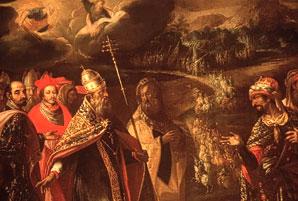
Today Rome celebrates the festivity of its two protectors: Saint Peter and Saint Paul. All the city (especially near the Vatican) it's decorated and there are hundreds stands. But why they are protectors of Rome? We are in the V century and Attila the king of huns was planing to invade Rome. So he took his troups and started to go to the city. Anyone in the city was worried because of him, also the Pope. So Leone I (the pope) with Trigezio and Avienno (two very important men) decided to go near the Po (the most important river of Italy) to stop him before he had reached Rome. The story tells that when they met Attila near Governolo (a little city) suddenly Saint Peter and Saint Paul came down from the sky with two flaming swords to protect the Pope and Rome from their enemy. Attila was so scared that immediately left his intent and Italy. Since that the day Saint Peter and Saint Paul are the protector of Rome. Ps: the image you can see, it's a paint of the event made by Borgani in the church of Governolo. For more post me a comment or e-mail me.

venerdì, maggio 12, 2006 

Santi Nereo and Achilleo

Today the Church celebrate the festivity of SS. Nereo and Achilleo. Those were two romans soldiers or most probably two servants of Flavia Domitilla the granddaughter of the Emperor Domiziano, one of the Flavi's noble family. They were converted to Christianity by Saint Peter during his permanence in Rome. Their owner one day made a vow of castity, and so they convinced her to honour her promise by giving up a marriage with the son of a consul. This man, angry, convinced the Emeperor Domiziano to punish them: infact they were exiled with Flavia Domitilla on the isle of Ponza. When Traiano became the Emperor they escaped in Terracina: here they still didn't want to convince Flavia to renunce to her vow, so Nereo and Achilleo were condemned to be decapitated. Their body were buried in the cemetery of Domitilla, but later they were moved in the a church called Titulus fasciolae. The name of this church derives from some bendages (fasciolae) that were found near Porta Capena (a door of the walls of Rome). These bendages were of Saint Peter. We talked about his permanence in Rome (here and here); in particular these were the ones that he had to cover his wounds and he lost them during his escape and the legend tells that these bondages are miracles. For more, post me or e-mail me. Dblk

venerdì, aprile 21, 2006 

The foundation of Rome

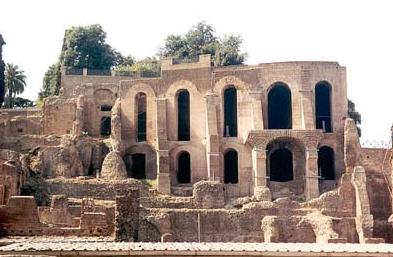
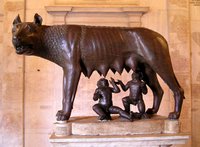
Today is the anniversary of the foundation of Rome. Infact in the 753 b.C. (April 21 as said from Varrone, a latin poet) two twins decided to build a new city. They were sons of a vestal named Rea Silvia. A vestal was a woman, a priestess who had to keep her virginity as a vow to Vesta, the divinity of the fire, preserver of the city and of every home. Her fire was lighted on March 1 and it was considered as a sign of the goodwill of Vesta; for this reason a vestal had to be the curator of this fire, a sign more important than her life. But we was talking about Rea Silvia. She was the most beautiful woman of Rome, but she wanted to keep her vow to the goddess; once she went in the forest and here she met Mars, the god of war who fell in love with her and lied with her. Their love was big and after 9 months she had two twins and called them Romolo and Remo; but at the same time she had betrayed the vow of virginity and for this reason she was condemned to be buried alive. The fate of the twins was different. They were dumped in the Tevere, the river of Rome, but they were saved from the roots of a fig tree. They sucked the milk of the tree and ate its fruits. Then when the splate of the river disappeared, arrived near them a female of a wolf that nursed them as two cubs. They were adopted from a shepherd, Faustolo, and form his wiìfe, Acca Larenzia. The two twins raised in this poor family, but one day the true came out. They discovered that their mother was the daughter of the acient king of Alba Longa (the city in which they live), Numitore, who was overthrown by his brother Amulio. So they decided to have their vendetta; they organized a little army and killed the king of Alba Longa. Numitore now was the king again and his grandsons asked him if they could build a new city. Once he told them that they could, Romolo and Remo arrived in a place near the Tevere. This place have a lot of hills and to decide in which of those hills the city had built they decided to see the flight of birds (this was a magic art). Romolo was the favorite one from this art and so he traced some furrows for the city on the Palatino (one of the hills, picture). Those furrows had to be not passed, but Remo did it and derided his brother; after this event the twins fought each other and Romolo killed Remo with his sword. Since that day Romolo was crowned king of Rome. For more information post me a comment or e-mail me. Ps: the famous statue of the wolf of Rome, it's the same on the right column. Dblk

domenica, aprile 16, 2006 

Happy Easter

Happy Easter! Buona Pasqua! Today it's the most important festivity for the Chritian world. The word Pasqua derives from the latin world Pascha and from the Hebrew Pesach that means passage. Once this feast was celebrated every sunday (because of its importance), but during the II century a. C. the Council of Nicea decided that this festivity should be celebrated only once during the year in a period between March 22 and April 25. In particular to choose the day of Pasqua it needs to calculate the first sunday after the first fool moon after the vernal equinox. There are a lot of symbols in this day. First the lamb. This rember the release of the Jewish people from the Egypt; infact Moses ordered to sacrifice a lamb to God just before the escape. But the lamb it's also a symbol for Jesus, pure and innocent victim. The second sign it's the egg. This is a symbol of renaissance, but it also represents the possibility of eat meal again because Jesus it's resurrected (infact every friday during the period before the Easter, Christians can't eat the meal) and this symbolize the center of the christian religion. Once the eggs were taken to be blessed before to give them to somebody as a sign of opulence. The last symbol is the dove. In the tradition this was usual to be shown just during the Pentecost (a feast in which the Spirit of God, represented with a dove, descended on the humanity), but today you can see it also during the Easter. For more, post me a comment or e-mail me. Dblk

martedì, marzo 14, 2006 

Santa Maria Maggiore

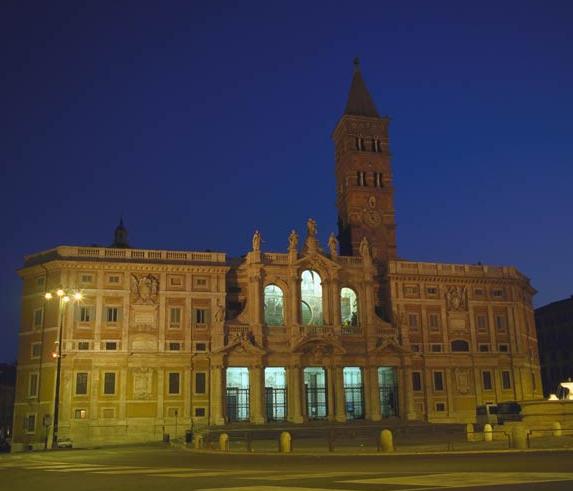
In the 352 Pope Liberio was intent on fighting the eresy of Ario. But the popular tradition seemed to forget this situation and about this period tells us one of the most famous fact of the religious story of Rome. There were a nobleman called Giovanni and his wife that weren't able to have a child. So they prayed Mary to give them a son. They promised to Her for this miracle anything She wanted from them. During the night of the 5 of August they dreamed the Mother of Jesus. She told them that they will have to build a church in the place where the following day they'd had found the snow. Also Pope Liberio that night made this dream. The 6 of August the both of them found a rectangle of snow on the hill of the quarter Esquilino. So they built a Church here and called it Santa Maria Maggiore. This is now one of the most important church of Rome (this is a Basilica). If you hadn't notice it, I remark you that it's very difficult that it could snow during the summer. Also the famous roman poet Belli wrote a poetry in the roman slang about this event.

La Madon de la neve è una Madonna
The (church of) Madonna of the snow is a Madonna
diverza assai da la MAdon de Monti,
so different from the (church) of the Madonna dei Monti
da quell'antra vicin'a Ttor de Conti
and from (the church) near Tor de Conti (a quarter)
e da quella der Zasso a la Ritonna.
and from (the church) near the Ritonna (a quarter).
Sopra de lei m'arriccontava nonna,
About it my grandmother was usual to tell me,
fra ttant'antri bellissimi ricconti,
between more other beautiful stories,
'na storia vera da restacce tonti,
a real story that will make stay without words.
che nun ze n'è ppiù intesa la siconna.
------------
Ciovè che un cinqu'agosto, a ora certa,
Id est that the 5 of August, in a special hour,
nevigò iun zimetria su lo sterrato
It snowed in a geometric way on the floor
fra Villa Strozzi e 'r Palazzo Caserta.
between Villa Strozzi and Palace Caserta.
E intanto un papa s'inzoggnò un sprennore;
Meanwhile the Pope dreamed a brightness;
e "va'", s'intese dì: "dov'ha fioccato"
"go" he heard a voice "in the place where it snowed
fa' fabbrica SSanta MAria Maggiore".
you have to make built Santa Maria Maggiore".
Ps: the picture you see was painted from Matthias Grunewald to celebrate this event. For more information post me a comment or email me. Dblk

mercoledì, febbraio 22, 2006 

Domine, quo vadis?

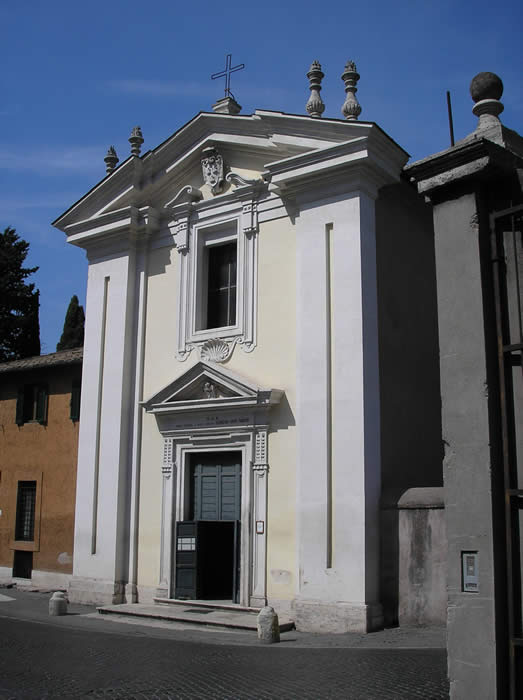
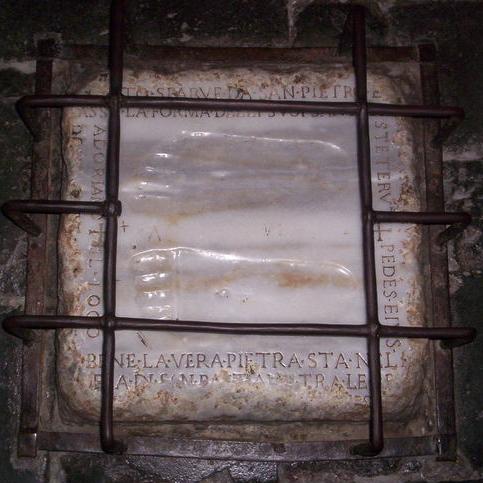
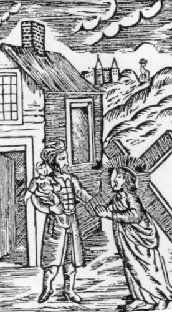
Maybe, once in your life, you have heard the latin quote Domine, quo vadis? The story of this sentence it's very particular. We are in Rome (as you could imagine). We are in the I century after Christ, Nero is reigning on the throne and he is persecuting christians. San Peter it's just escaped from his jail and now is trying to leave Rome. Suddenly, while he was walking he saw Jesus. Scared and happy at the same time to see his Magister, aked Him: "Domine, quo vadis? (Signore, dove vai? Lord, where are you going?). Jesus looked at him and replaced: "I'm going to Rome, to be crucefixed again". Peter looked at Him astonished: "You will be crucifixed again?". Jesus answered: "Yes, I will be crucifixed again". Saint Peter, the man who revealed the real nature of Christ, finally understood those words; infact he immediately said: "Lord, I'm coming back to Rome to follow you!". In that moment Jesus rised up to the sky and the first Pope, looked His Lord in His holy brightness; now he felt consuled and he knew what he had to do. He saw that his duty was to come back to Rome to glorify Jesus with his martyrdom; so he went to in the city and here he was crucifixed counter. This was the story. Today in the place where Saint Peter met Jesus, there is the church of "Domine, quo vadis?". In this church there is the copy of a stone (the original is in the church of San Sebastiano) with the mark of the feet of Jesus. Ps: if you want to e-mail me write to dblk1@hotmail.it (this is also my MSN code). For more post me a comment. Dblk

martedì, gennaio 17, 2006 

The wandering Jew and Rome

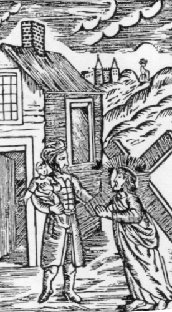
A legend said that when the situation in the M.O. gets dangerous, suddenly a man appear: he is an old man, with a long white beard and thicks hair. He has a lot of names: someone call him Joseph, others John, others Assuero. The legend tells he is immortal and that he lives since the Passion of Jesus. But, who is this man and why is immortal? The story tells that when Jesus was walking in the Calvary He was so exhaust that He had a rest near a workshop; a lot of people insulted Him meanwhile soldiers were hitting Him. The owner of the workshop was a disciple of Jesus, but he didn't want to be recognized, so when he heard that clamor, came out and told to Jesus: "Come on, go away from here! Don't settle here! Hurry up!". Once He heard him, Christ replaced: "Well, I will settle soon, but you won't do it until my return". Suddenly, just after Jesus was crucified, this man was taken by an uncontrollable power that imposed him to start walking. So, since that day he is still walking around the world. But this is a blog about Rome. We are in the 1944. Nazies have occupied Rome. In all the city German soldiers were looking for Jewish men and others Romans. Someone told that a troop arrested 17 men. Since the moment they were banged up they knew they'll probably die the same day. When they were already resigned to this idea appeared a man with the unmistakable traits of an old Jewish. He came near a guard and told him that he was the one they were looking for and that he will tell anything they want, but before of doing it they had to release everyone. When they did it, the men was interrogated and since he didn't knew really anything just said to be guilty. The verdict was death warrant. Soldiers prepare their weapons to kill him, but at the moment of shooting the old man got down on his knees, united his hands and then he raised them up to the sky and disappeared. If you want to know more, post me. Dblk

venerdì, gennaio 06, 2006 

La Befana

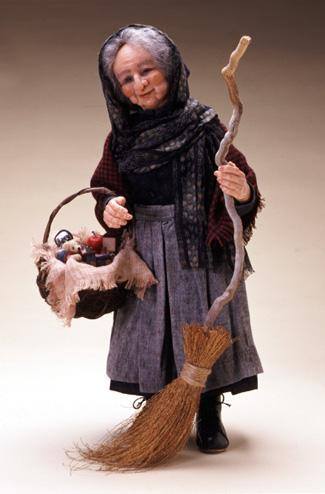
Today is the feast of the Epiphany. Epiphany is a christian feast intended to celebrate the shining forth or revelation of God to mankind in human form, in the person of Jesus. The observance had its origins in the eastern Christian churches, and included the birth of Jesus; the visit of the three Magi, or Wise Men (traditionally named Caspar, Melchior and Balthasar) who arrived in Bethlehm. But in Rome there is also a second feast. This is the feast of the Befana (whose name derives from Epiphany). The origin of this tradition derives from ancient pagan costume. But, who is the Befana? The Befana is an old woman who gives gifts, just like the 3 Magi did with Jesus. She wears a big black full skirt, an apron, a shawl, a kerchief or a hat in bad condition on her head, a pair of slobs shoes. During the night between the 5 and the 6 of January, riding a broom with a sack full of toys, chocolate and candies, she goes into the house of every child and fills stockings with her gifts. Children prepare for her a mandarin or an orange and a glass of wine; in the morning of the 6, they will find a consumed meal and the hand-mark of the Befana. But they could also have a bad surprise: infact if they are bad children, they will find carbon instead of prsents. If you went in Rome during these days, I recommend you to visit Piazza Navona: infact, this square, for this feast, is filled with hundreds of newsagents. A last thing: the Befana, for the tradition, lives in Via Padella, 2 in Rome. For more informations, post me. Dblk

domenica, gennaio 01, 2006 

Buon anno nuovo


Happy new year! For the new year in Rome (and in Italy) we use to hurl from the window old things. This tradition wants to erase the bad things of the last year to start a new good one. We just chuck little things (for example the tap of a bottle), but if you go in the southern Italy you can see also straw chairs and little closets. Dblk

domenica, dicembre 25, 2005 

So this is Chritmas

Vi auguro un Buon Natale, sperando che i vostri sogni si avverino. I wish you a Merry Christmas, and I hope all your dreams will come true. So, it's Christmas time and here is a story about it. The origin of the festivity of this day it's been very talked-about. At the end of the III century Christmas was celebrate in differents dates: March 28, April 18, May 29 or January 6. It seems to be sure that in Rome this festivity was honuored the December 25 since the IV century, under the pontificate of Pope Liberio, but just with Giulio II this became the official date. For the choise of this day had a lot of importance the civil calendar of Romans: infact in this date there was (for this calendar) the winter solstice also called "Dies natalis solis invicti" (Natale del Sole Invitto, Birth of the invincible Sun). Christians wanted to overlap to this pagan day of the Sun the birth of the real sun, Christ, that was called Sole di Giustizia (Sun of Justice). The tradition of the mistletoe derives from a Celtic usance: infact it was considered as gift of the gods, because it had no roots and it grew as a parasite on a branch of another plant. A legend tells that it could be found in a place where a thunderbolt was fallen (it's a symbol of a descent of a divinity and so of immortality). So this divine nature of the mistleoe, inspired christians and it became a symbol of Jesus: like this plant is a guest of a tree, so Christ is a guest of the humanity. Buon Natale. Merry Christmas. For more, post me. Dblk

domenica, dicembre 04, 2005 

Superstitions

Rome is a city full of superstitions and legends as you can see reading this blog. Some derives from the religious faith others from the popular one. Here are some of them. If you see a priest or a white horse when you are just got out from your house, it takes a lot of luck and, especially if you see a hunch-backed with two humps, everything in your day will be fine (moreover you have to touch the hump of him); but if he has just one hump you will be unlucky. To avoid the plight you have to make the horns with your hand (in particular with the forefinger and the little finger). If you want to be lucky, you have just to put a nut or a hazelnut or a chestnut in your pockets; instead if you want to take a little bit of fortune in your house just try to find a lizard with three tails (but it's very difficult to discover one of them) and take it alive in your habitation; another tradition to become lucky is to put a shoe (especially if you find one of them in the street) behind the door. A last thing: once you hear the Ave Maria (it's a ring of the bell of a church that remembers to pray at 6:00 pm) don't sweep because if you do it with the dust you will erase the fortune too. For more, post me. Dblk

giovedì, novembre 24, 2005 

The ghost of the Campidoglio

"Giovedì 26. Festa di S. Anna, ed alle 12 cadde pioggia impetuosa. Siamo nell'anno del Signore 1731. Francesco Valesio". Our story starts with the words of a narrator of the XVII Century, who describes a famous event. "Thursday 26. Holy day of S. Anna and since noon it was raining a lot. We are in the year of Lord 1731. Francesco Valesio". This is the portraying of a rainy day in Rome, in particular we are in the jail of Palazzo Senatorio, near the Campidoglio. A busboy of a barber was arrested because of a rough-and-tumble and he was put in this prison. He was in his cell when he noticed that he wasn't alone: with him infact there was an old man, with a long white beard, in full dress. The young boy asked the reason why he was in this place and the man started to tell his story: he was a senator who lived during the age of Giulius Cesar. The young boy was so gentle that the other man decided to give him a golden coin. The boy surprised from his generosity (moreover he didn't believe the senator was a ghost) asked him other money. The senator said that before doing it, he wanted to put flats out of the cell so the guardian won't get hungry and that he will be back for the ispection time. Anyway the guardian went near the cell of the busboy sooner and when he found the flats outside, he tought that the young man was escaped; but when he went into the cell he found him here. He was surprised, but the prisoner told him about his mate. The guardian obviously told him that he had no mate in this cell, so the both of them was surpised and a little of bit scared. When the senator came back, told to the boy that by telling everything to the guardian he just lost the opportunity to become rich; he said that he had 3 boxes full of money for him and then he showed them; the boy was petrified and he was just looking the boxes on the floor and then he saw the senator living the cell. So he screamed, but when the guardian arrived the senator was disappeared and on the floor there were just 3 bricks. The ghost of this senator appeared again to other prisoners, living, the most of times, just the bricks. For more, post me. Dblk

mercoledì, novembre 16, 2005 

Miraculous icons: le madonnelle

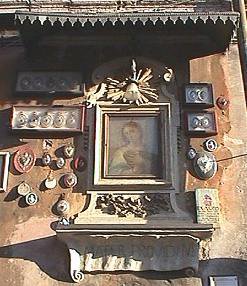
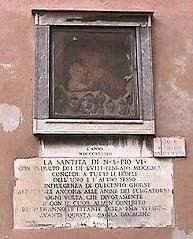
Romans call "madonnelle" (little Madonnas) those icons put in a wall of a street; you can find more than 500 icons in Rome, especially in the old town centre, but once they were thousands. Most of them are dedicate to the Mother Mary; this custom derives from the usance of the acient romans to build "lares compitales", altars dedicated to a pagan deity. Romans are very wedded to them because those icons made a lot of miracles during years. The most famous miracle happened in the 1796: from July 9 for 3 weeks these pictures of Mary started to move their eyes. During this time, french troops were close to invade the city, so romans thought that it was a very bad omen (infact 2 years after this event, Rome was attacked from France). Now you can think that is just a legend, but during these facts the Church made a serious enquiry to prove the miracle (infact not all the icons were recognized as living miracles). According to the descriptions of the inquiry started from the religious authorities, in some cases the movement of the eyes happened from right on the left, in others was vertical; in the same days in which the above-mentioned icons continued to move their eyes, another one situated in via Baccina (behind the area of the Imperial Holes) made revive a flowers bucket. For more, post me. Dblk

domenica, novembre 06, 2005 

Eating in Rome

If you come in Rome and you want to eat (especially if you are guest in a house), it's good to you to know what you can do or not when yuo are eating. First you don't have to cross culteries because it's very ill-omened: that's because it remembers the death of Jesus. If you make fall the salt it's a bad thing: infact a legend tells that when you will die you'll spend 7 years in purgatory (to avoid it, pick up the salt or dump it behind your shoulders). When you sit down near the table to eat with friends, you must be more or less than 13, because if you don't, during the year, the littlest or another one of those that ate with you will die. When you are a guest you don't have, at the end of the meal, fold the napkin because if you do it, you won't come back in that house again. A last thing: keep in your mind that when the table is set, you can't play any game, because on a set table soldiers played with the dress of Jesus. For more, post me. Dblk

domenica, ottobre 30, 2005 

Why Piazza del Gesù is so windy

Piazza del Gesù (the square of Jesus) is probably the most windy place of Rome; but there is a particular motive to explain it. In Rome there is a legend that tells that once the devil and the wind were walking together in this area and when they arrived near the Church of Jesus, the devil said to his mate: "Wait for me here. I have to make some damage there. I'll be back". Since that day, the devil never came out and the wind is still waiting for him. That's why this place is so windy. For more, post me. Dblk

domenica, ottobre 23, 2005 

The basilica of Saint Paul

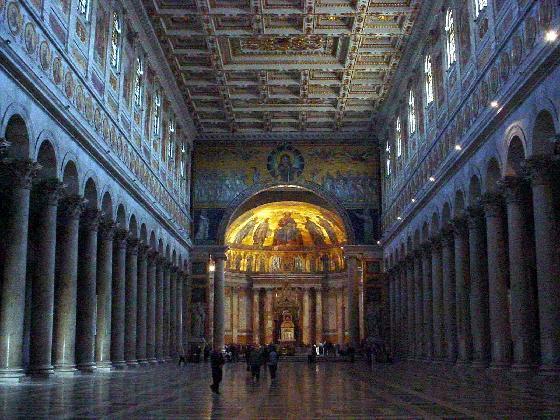
The church of San Paolo fuori le Mura was consecrated in the 324 by Pope Silvestro with the will of Emperor Costantine; here there is buried the body of Saint Paul. In this basilica you can see a series of images (icons) of popes, 266 exactly; but here there are still some empty spaces, that will be filled with the faces of future popes. So, there are still 28 empty spaces and a legend tells that when them will be stuffed, there will be the end of the world. For more, post me. Dblk

martedì, ottobre 18, 2005 

The rival of Jesus: Mithra

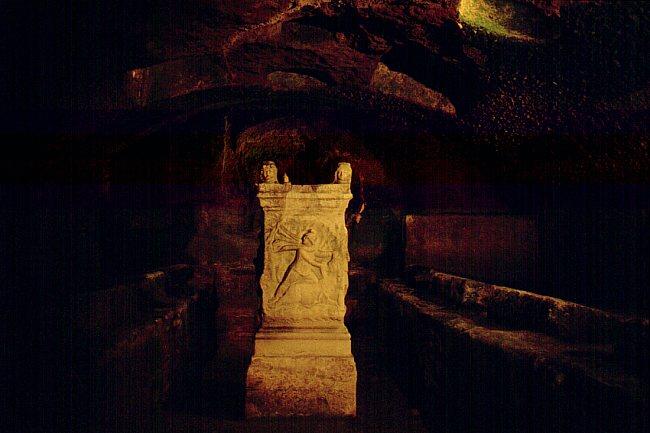
Two thousand years ago, in Rome, a new cult was getting famous. Practiced in caves, it tells about a god that was born December 25 from a Virgin; he preached a message of brotherhood and solidarity. This god before leaving earth, made a last supper with his disciples, breaking bread and giving wine to them, then he ascended: he was 33 and his name was Mithra. This is a difficult research that I made, first going to the church of San Clemente, near the Colosseum: infact, under this church, there was a temple dedicated to this god. So, what is this cult? Let me make an example: immagine for a moment that today instead of Christianity, there is the cult of Mithra. This could be a Mass. Instead of the crucifix, there is the immage of Mithra killing the cosmic bull (plants and animals are born from its blood); near this picture there is a simulacrum of the sun (symbol of the god of the sun, friend of Mithra). There is a "pater" (for the priest) with two men close to him: Claute, with a torchlight put up to symbolize the sunrise, Cautopate, with a tochlight put down to simbolize the sunset (this cult give a lot of importance to astronomy and astrology). Just after the preaching, there is a theatrical representation: for example about Zeus. The bread, in fine, is given from men with a mask of a crow while faithfuls are lying down on beds. I have to say that this was a secret religion and that it was revealed just to some people: moreover to know anything about it, it had to reach the first extent. There were, infact, a lot of degrees: when a man (there were not women) joined it, became a Crow, protected from Mercury, then he got a Nymphus (symbolize from a grub or a snake that is changing its skin) under the protection of Venus. Then there were the Miles (soldier) under Mars: to became it, a man should steal a sword from another man during a battle. The Lion, under Zues, was the next level; then there were the Persian, safeguard from the Moon, the Eliodromus fostered from the Sun and, at last, the most important extent, the Pater (father) who was the minister protected again from Mercury. I have to add that sometimes (very few times) there were women: they became Hyenas or they followed the same path of men. At the end, what are the differences from Christianity and the cult of Mithra? I have to start from the similarity: in addition to the incipit, both of them baptize with water and promise a resurrection; Mithra, just like Moses and S. Peter, made streamed water from rocks. There are, anyway, differences and explanations: Mithra was born from a rock, but years later this was probably associated to Jesus'cave. The birth date of Mithra (december 25) was used for the one of Jesus because it was the festivity of the sun and it was near the winter solstice (moreover it was used from other religions too). Baptizing with water was common and the resurrection was pointed up from disciples of Mithra to scoop christians (moreover they believed in the reincarnation and so they were vegetarian). There are not evidences of the life of Mithra, instead there are of the one of Christ. Lastly a quote of the historian Ernest Renan: "If Christianity was been stopped from a chronic disease, maybe today we'd believe in Mithra". For more informations, post me. Dblk

venerdì, ottobre 14, 2005 

The ghost of Donna Olimpia (1592-1657)

This is the story of one of the famous ghosts of Rome. Donna Olimpia was a girl who was so impudent and beautiful to become the wife of a rich man of Rome despite she was poor and she was boned in Viterbo ( a small village near Rome). Her husband died suddenly so she inherited all his money. Now she was rich, but her lucky star was just starting to surprise her: infact she maried Pamphilio Pamphilj one of the most powerful man of Rome. Noreover he was the brother of the cardinal that became Pope Innocenzo X. Her new husband died few years after their holy matrimony so she was lonely again, but now the situation was different. She was rich, she was young, she was the second powerful person of the city; that's because she was the only relative of the Pope so anyone that wanted to have business in Rome went to her with gifts to have the goodwill of the aristocracy. But her lucky life ended in the 1655: Pope Innocenzo X was dying and she was smart enough to understand that without her protector she was in a dangerous situation. Infact anyone that wanted to hae a revenge against her could now act without any concern (a lot of romans infact hated her for her position and apathy for their troubles). So she took two trunks full of gold and left the city crossing Ponte Sisto (a bridge). No one saw Donna Olimpia again, but there is a legend: a lot of people tells they have seen her ghost riding a black lorry among Ponte Sisto chuckling against Rome and romans, and they affirm that is a very scary experience. For more, post me.

lunedì, settembre 19, 2005 

The ghost of Luca de Marchettis

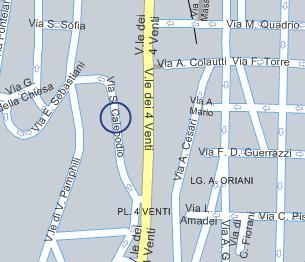
I've already written about nobles ghosts: this is a new story. The zone of Monteverde, exactly on San Calepodio street, it seems to be hunted by the ghost of Luca de Marchettis, a nobleman who killed himself jumping from a balcony of his house. The villa today appears as decadent and almost covered from ground ivy and just for these things it seems scary. Neighbours tells that during the night this villa is alive: they say that there are lights turning on and off itself without anyone touch them (no one, infact, lives in this house) and they hear steps. Other people affirm that they saw the ghost of Luca de Marchettis walking in this way and then coming back home and sometimes heard a thud, the thud of the suicide nobleman. So don't be surprise if romans who lives here don't want to cross this street. For more, post me. Dblk

venerdì, settembre 09, 2005 

Living miracles in Rome

In the Basilica "SS. XII Apostoli" (Santi Apostoli square, picture) the blood of San Giacomo Maggiore is melted from a lot of century. You probably know that once taken from the body, the blood became solid soon, but this one in the church, is still liquid. You can see another miracle in the church of San Francesco Saverio della Garbatella (Via Daniele Comboni, 2): infact here you can find the undamaged arm of the saint. Undamaged is also the heart of San Camillo de Lellis, keeped in a Chapel of the church of Santa Maria Maddalena, near the Phanteon. For more, post me. Dblk

martedì, agosto 30, 2005 

Mistery of an island: Isola Tiberina

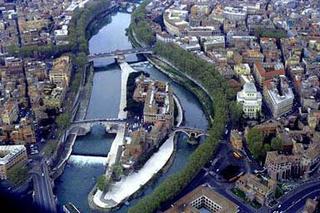
The isola Tiberina (island of the Tevere, the river of Rome) is situated in the old town centre. A legend tells that this island derives from a rebellion of Rome. Infact when the ancient romans sent away their king Tarquinio the presumptuous, his assests were chucked in the stream. After a pair of years the mud accumulate itself on those, creating the island. Another story of its creation narrates that this once was a warship sinked here. If you take a look to the picture you can see that it is similar to a vessel; moreover in the island there is an obelisk located to be something like a sailboat. But this island is also been known as a place to cure ills. That is because once in Rome, in the 293 b. C., there was the plague; so to remove it, came a boat from Epidauro (in Greece) bringing the snake of Esculapius (the god of the health and medicine: the snake was his hloy animal). When this arrived in Rome the snake escaped from the vessel and put itself in the island waiting here for a while and then suddely disappearing. Romans took this event as a volunty of the god to stay here, so they constructed a temple for this divinity: a part of this is probably in the church of S. Bartolomeo. This building "de insula" infact(on the island), developed in the X century, has the well and some column of the ancient temple of Esculapio. About the church on the pediment there is written: "IN HAC BASILICA REQUIESCIT CORPUS S.BARTHOLOMAEI APOSTOLI" (In this basilica there is the body of the apostle S. Bartolomeo). A last thing: in this area there are today two hospitals, one of them was constructed form friars. A lot of people tells that here they saw a procession of hooded men walking and suddenly disappearing: someone thinks they are friars, but most probably they were members of a secret society that were buried here. For more, post me. Dblk

giovedì, agosto 25, 2005 

La fontana del facchino (fountain of the porter)

On the wall face of the palace on Via del Corso, there is placed the Fontana of the Facchino (fountain of the porter): fed from the Vergine Water, originally fixed on a house in public square of the Crociferi and finally transfered on via Lata in 1874, on the flank of the afore-mentioned palace. It is a work of Jacopino of the Conte, constructed around to 1580 for assignment of the Corporation of the Water carriers. Who is the carved man? There are a lot of stories about it, but I can say that 3 of those are most probably. Number 1: the statue is Abbondio Rizio, porter, lover of the wine, as once written on an epigraph by the priest Godard. In this epigraph Godard said that he was crowned on the pubblic square and he died after a lot of years of work (the latin quote "in publicis stillicidiis coronato", means that he was crowned in the street: that's because it was a tradition, infact olders persons were usual to drag their heirs to show anyone that those were their wishes). Number 2: he is M. Antonio De Dominicis, a nosey Jesuit imprisoned from Pope Paul VI in Castel Sant'Angelo, who poisoned himself. Number 3 (a famous legend): he was a host who gained a lot of money mixing the wine with water. But when he died and appeared in front of Saint Peter to be judged, he had a surprise: infact the Saint told him that to join the Heaven, he must give back what he stolen: so, to do it, he had to pour all the water he poured in wine when he was alive. He is still sloshing. For more, post me. Dblk

martedì, agosto 16, 2005 

The Lapis Niger

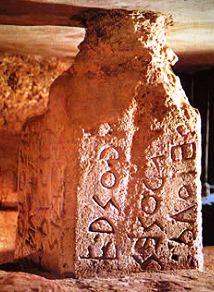
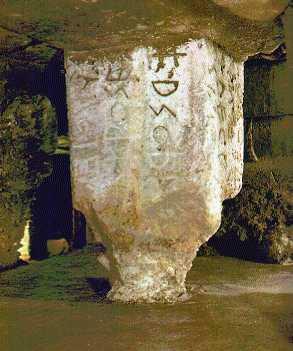
The Lapis Niger is one of the most baneful place in Rome. What is the Lapis Niger? The discovery of it was in the XIX century: archaeologists immediately thought to a poem written by Festo. A quote of this poem told about a black stone near the Comizio (lapis niger in Comizio) considered as a baneful place because it was probably the tomb of Romolo (the first King of Rome) or because it was the place in which he were murdered. Other excavations found out that under this place there was an altar and a part of a colomn or a pedestal. On this pedestal (or colomn) there are written words in a language that is similar to an ancient greek, used before the VI century b.C. (so before the republican age). This epigraph it's hard to be translated, but it tells that this was a holy place and it threatened thieves with terribles punishmets and curses. The presence of an altar an a statue may indicate that it was temple (but it could be a tomb too). Today in Rome we say that this stone "porta jella" (it takes bad luck), so don't touch it. If you want more information, post me. Dblk

martedì, agosto 09, 2005 

A famous Saint of Rome: Alessio

One the more interesting churches of Rome is surely Sant' Alessio on the Aventino. The memory of this roman saint has been officially cancelled from the calendar of the Church, but the memory of his saints actions keeped the cult alive through centuries: his history was drawed on the wall of the basilica of Saint Clemente, sung from cantors, put in poems from poets and in the 1634 became an opera of Stefano Lando. The legend begins from a lacked wedding: Alessio, lived in V the century, son of the senator Eufemiano and Aglae, in the day of his wedding with a rich roman girl he decided that it wasn't what he really wanted. After an explanatory talk with the future spouse, he left the beautiful parental home; dressed with only a poor robe, he started to travel. He arrived in Palestine where he lived of hand out. Then, after a lot of years, he decided to return in Rome. He knocked to the parental home, but - for the long beard and moreover he was older - he does not been recognized. Believing him a pilgrim, they offered him to lodge in a under the stairs of the palace. Here he lived seventeen years, nourishing himselves with the paternal charity and drinking the water of the close well (still today in full efficiency in the courtyard of the church). His true identity was revealed from a letter to the father, only when Alessio died. The Pope and the emperor saw in him "a man of God" and venereted him. The story tells that the bells of Rome, without any human touch, started to play itself and that in the palace there were wonderful fragances. The stairs, that were the roof of the saint for long years, it is keeped in a big glass reliquary in the church. In the roman tradition, Alessio is the Saint that tells the numbers to play to the lottery. In order to obtain the numbers, who addresses to Alessio must pray nine days and be awake on the house stairs, in memory of the mortification chosen from the saint. For more, post me. Dblk

giovedì, agosto 04, 2005 

The walnut tree of Nero

Near Colle degli Ortuli, in Rome, there was the real tomb of Nero (but it isn't sure). The insane emperor, who killed himself, was buried here from his nurses, and upon the ground of the tomb was planted a walnut tree. Acients chronicles tells that the place was elected from demons as special place for their assembly. Later also the famous witches of Rome decide to have their congress here under this walnut (meanwhile this tree became unbelievably big). 1000 years later the Pope Pasquale II decided to do something to stop them: in the 1099, after having dreamed the Mother of Jesus he ordered to dispel ashes of the emperor in the Tevere and to build a church on the ground that once was the tomb of Nero. The tree was slashed and here there was built the church of Santa Maria del Popolo. For more information, post me. Dblk

giovedì, luglio 28, 2005 

Castel Sant'Angelo

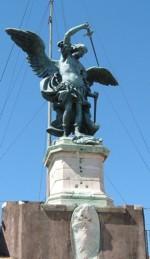
One of the most famous monument of Rome is Castel S.Angelo (S.Angel Castle), once known as Mausoleo of Adriano (tomb of Adrian). Why this new name? The legend tells that once in Rome, (during the moyen-age) the plague was killing the whole population. So the Pope ordered to organize a procession with the most important holies objects and he decided to be part of it. So when he and the people of Rome arrived near the tomb of Adrian they saw an angel with a shining sward coming from the the sky. The Creature of the Heaven moved his arm and then he disappeared. Few days later there were no trace of the plague. So the Pope decided to put a bronze statue on the top of the tomb. So, today, this monument is known as Castel Sant'Angelo. For more, post me. Dblk

lunedì, luglio 25, 2005 

Haunted library

In the zone around to Peace square, there is a library where students go to find books for their jobs. A night, when the caretaker of the library gave the closing warning, a friar that was studying seemed just not to want itself any to go; the guardian repeated it more times that he had to close, but the friar did not answer. So the man got angry and swore: suddenly the friar raised himself and gave him a slap. The poor caretaker fell to earth, passed out. When the morning after was waked up, someone who was helping him, told him that he had to stop drinking too much... but the signs of the five fingers that he had on the face remained a mystery!
This event is so famous in Rome that became a movie: the name is "Fantasmi a Roma" ("ghosts in Rome") and in the cast there is also Marcello Mastroianni. If you want to meet the ghost you have to go here very soon or late (just few moments before the fastener). For more, post me. Dblk

mercoledì, luglio 20, 2005 

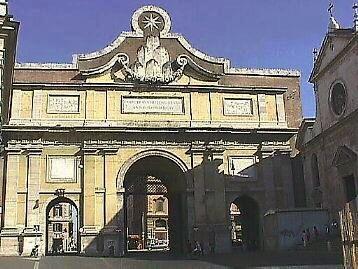
Sisto V

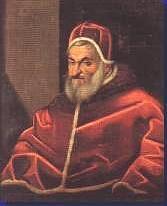
One of the most famous Popes was Sisto V (1585-90). This Pope was elected because he was a man who was usual to enforce the law in a time when the corruption was everywhere in Rome (infact he was a grand inquisitor): for this reason, very soon, he was called "Papa Tosto" (Strong and stony Pope). There are a lot of legends about him: this is one of them. One day Sisto V called the hangman: he ordered him to build a gallows near Piazza del Popolo and to string up the first person who had entered in the city through Porta del Popolo (a gate near Piazza del Popolo. Once, infact, Rome was enclosed from walls). The executioner was baffled, but he knew that it was better to follow orders for his safety. The next day the executioner and guards were pryings to know the unlucky man that will be killed there. The gate was opened. A young boy was coming here, but suddenly he stopped himself to tie shoe laces; during that time an old man set foot in Rome. Guards immediately arrested him telling him the bad new: the man was terrified, but just for a moment. Then, infact, he raised his hands to the sky and told: "Oh Dio onnipotente, quanto sei giusto!" ("Oh omnipotent God, you are right!"); he told to the hangman that a lot of years ago he killed all his family and then other 4 persons and that no one accused him. So the executioner was relieved to realize orders. But still today no one can tell how Sisto V could know it. Ps: the spirit of this man found the peace, but it isn't so for the others souls that died here: they appear here or long the twisted wall (read the article). For more, post me. Dblk

martedì, luglio 19, 2005 

The crypt of the Cappucini

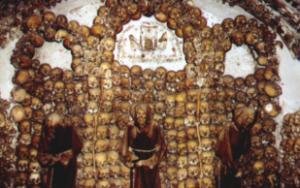
Nearly to the end of via Veneto, near Barberini square, a church rises whose dedication original is to S.Maria of the Conception, but that in Rome he is more known like "the church of the Cappuccini", the friars whose robe has a brown and white hood, from which - strange but true - it's been taken the name of the popular one cappuccino of the bar. Many between Romans and tourists know this single church in virtue of that stranger, in Rome, it can be visited: the old cemetary under the building, a tightened corridor that leads to a series of nails head whose walls and vaulting covered from baroque decorations. But to realize the beautiful figures they didn't use neither filler, neither marbles, but skulls, teeth, long bones, fingers and whichever other coming from part give beyond 4.000 skeletons, once Cappuccini friars. The final touch is the maxim of the cemetary, that tells "noi eravamo quello che voi siete, e quello che noi siamo voi sarete" (literally :" we were what you are, and what we are you will be"). To visit the church you have to go to via Vittorio Veneto 27 - open time 9-12 and 15-18. For more, post me. Dblk

lunedì, luglio 11, 2005 

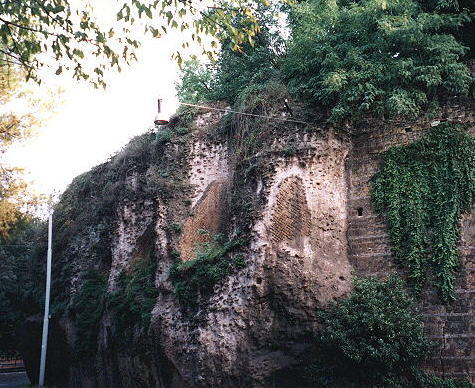
The story of the "Muro Torto"

It's called "Muro Torto" (Twisted Wall) the wall built during the moyen-age and called "Murus Ruptus". Just like others stories that you can find here, there is a legend about this wall. In particulary there are two legends. A good one and a bad one. The first. The story tells that S. Peter defended Rome in this point every time that the city was assailed. So, no one wants to repair or destroy this acient wall because its own of Saint Peter. The second. The tract of the wall from Flaminio square to via Veneto it's called "Evil Wall" because here, there were buried the bodies of robbers and whores. Moreover here there are the bodies of Targhini and Montanari (two rebels decapetated in the 1825 for their action): ghosts of this two men are usual to appear near this wall with the head in their hands and they gives numbers of the national lottery to those who sustain their terrible look. Another story tells that the influence of the damned souls is very ill-omened: infact long this wall, on the top of it, there are goals to avoid suicides. This place is also indicated in maps as "Sepulcrum Neronis" (Nero's tomb). The spirit of Nero showed itself during decapitations and murders: people noticed him because a scary chuckle resonated when those events happened. A last thing. Drivers today often ends the gasoline of their cars when they are near the wall, but they are not suprised, especially if they are romans: ghosts of the "Twisted Wall" like to do this joke to them. For more, post me. Dblk

mercoledì, giugno 22, 2005 

Lucky water


If you are in Rome this friday (June 24), at the midnight, you have to go to the obelisk in San Giovanni and drink (or wet yourself with) the water of the fountain. Infact the June 24 is the festivity of San Giovanni and since the moyen-age, romans always drink the water of the obelisk to avoid bane and witches. It takes a lot of luck. For more, post me. Dblk

martedì, giugno 07, 2005 

Via della Gatta


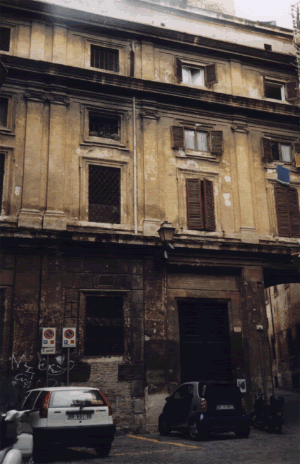
The name of via della Gatta (the street of the cat) derives from the marble statue of the cat found near the temple of Isis (so it was a divinity), and situated on the first cornice of Palazzo Grazioli. About this cat there is a legend:if you look in the same direction of the cat, you should find a treasure. For more information, post me. Dblk.

domenica, giugno 05, 2005 

The forum of the Peace and the Ark


The forum of the Peace was built during Flavi's age to celebrate the peace in whole empire of Rome abd it was considered the 8th marvel of the world. At the two sides of the temple of the peace there were two libraries, one greek one of Rome. Then this area became a museum in which there were collected all treasures stolen from every population conquered by Rome. So here you had could find treasures of battles of Vespasianus and Titus. Titus in 71 conquered Jerusalem, so he took its treasures, including those that were protected in the temple. Those important things arrived in Rome (a trial are the bas-reliefes in the Arch of Titus): some of them are still in Rome today (for example the golden candelabrum that now you can see at the Vatican Museum). A legend tells that in the booty of Titus there was also the legendary Ark of Alliance: if it is true, the Ark now should be in the Vatican Museum, propriety of the Vatican. For a comment, post me. Dblk.

sabato, giugno 04, 2005 

Mamertinum: the prison of S.Peter


Under the church of San Giuseppe Falegname, there is the most famous prison of the ancient Rome: the Mamertinum. This prison was considered by Romans as a negative place because of the lot of people who found his death here: for example Caius Graccus and Catilinae (a revolutionary). But surely the most famous prisoner it's been S. Peter (other versions of the story tell us that there was also S. Paul with him). The story tells that he was chained here and that his guards didn't give him anything to eat or drink: so Peter made a tullus (the name of this part of the prison became Tullianum) a well and with the water of this well he baptized his guards Processo and Martiniano. Then he escaped with the help of an angel. Another detail of the story describe S. Peter that, when he was going down the stairs to reach the prison, fell and hit the wall with his head, leaving his mark on the same wall. To visit the Mamertinum (9-12 am / 2:30-5 pm) you have to go to Via dei Fori Imperiali, just after the temple Concordia. If you have any questions post me a comment. Dblk.

venerdì, giugno 03, 2005 

The ghost of Umberto I


I've already told you about "nobles" ghosts. This is the story of a particular one. We are in 30's in front of the Pantheon. Once a temple of Rome, then a church, now (it is still a church) it is a sacrarium of kings of Italy: for example there is the grave of Umberto I of Savoia, killed in the 1900 in Monza. His ghost is usual to appear around the monument and this is the same spirit of our story. As I told, we are in 30's and the ghost of the King Umberto I appeared to a guard telling to him a very important political message, but it remained secret. The trial is that the King left his "flaming" mark on the sleeve of the scared guard. For more informations post me a comment. Dblk.

lunedì, maggio 23, 2005 

"Nobles ghosts" of Villa Bessarione


This villa is situated on Via Appia Antica near the church of San Cesareo: as the legend tells, this should be the ideal place to meet ghosts. But they are not simples ghosts, they are nobles. Those are the souls, infact, that were usuall to get reuite in the villa with the Cardinal Bessarione, a Greek monk. Their appearances are very discreets: they appear, gently smile to you and then they disappear with a noise of a little bell. A noble is always a noble. For more informations post me a comment.


Souls of the church "Sacro Cuore del Suffragio"


In the 1893, thre priest Vittore Jouet, bought a big area on Lungotevere Prati, in Rome and he wanted to build a church in this place. This church called "Sacro Cuore del Suffragio" has a Gothic face as the project of Giuseppe Gualandi provided for. The september 15 of the 1897, in the chapel of the "Madonna del Rosario" (into the church) burst a fire. Once put out the fire, the priest noticed a strange icon beside the altar, made by flames: it seemed something like a melancholy face. Vittore Jouet was sure that it was the figure of a dead man who was trying to contact him; he said that this soul was in the Purgatory and was asking for prayers to go soon in Paradise. So he decided to look for some people with his same experience and when he found them, he built a museum inside the church called "Museo delle Anime del Purgatorio" (museum of Souls of Purgatory). In this museum you can find a lot of experience of this kind: for example the one of Giuseppe Stitz dated, December 21 of the1838. He was reading a book of prayers and suddenly the mark of an hand appeared on the book; moreover he said that he heard the voice of his dead brother asking for prayers and for a Mass to reach Heaven earlier. You can see the book and more other objects with a lot of marks in the museum. To visit the church you have to go to Lungotevere Prati, 18 asking to visit the museum at the secretariat of the church.

domenica, maggio 22, 2005 

Spirits of Via dei cessati spiriti


The particolar name (to make you understand, it's something like "disappeared spirits") of this street derives from the presence of a famous "Osteria" (a restaurant) called "Cessati Spiriti" (disappeared spirits). The story tells, about it, that travelers who half their travel here, were always stolen of their carts. Travelers, infact, going out from the restaurant, could just see the wind moving the grass in front of the palace, so they accused spirits for every single theft. During the XIX century, to disinfest this area from spiritswas put, on the front of a palace of the street, an icon of Mother Mary . From that moment, there were no more spirits in the street: so dwellers started to say "spirits are disapperared"(gli spiriti sono cessati). This icon was destroyed by unknows few years ago and from that day in the zone the story of the spirits is back. For more informations or just for a comment post me. Dblk.

venerdì, maggio 20, 2005 

The mistery of villa Stuart


In Rome at the 5952 of via Trionfale there is a clinic built on the rest of a villa of the XVII century. Let me tell you something about this villa. During the XIX century it was bought by Emmeline Stuart and her boyfriend Lord Allen. The woman was usually to spent her time on spiritics sessions. She was so good doing it that ghosts decided to stay always in the palace (not only during her evocations); Lord Allen changed his hobby: he choose to talk with demons instead of gardening. Servants, scared of the frequently poltergeist (flying tables, objects and pots crashing on the wall,...) left their job. One day Allen disappeard, but no one cared about it because it all happened in the villa: everyone tought that he was "recovered" from his strange hobby and so he decided to left his lady. Emmeline told that, during every night, she was usual to put an hand in a wall in the cellar to touch the fingers of the Lord and said that he touched her fingers too. A lot of years later the wall of the cellar was destroyed and the body of Lord Allen was found here. For more informations post me a comment. Dblk

giovedì, maggio 19, 2005 

Villa Manzoni


In the 1925 some relatives of the famous italian poet Alessandro Manzoni, noticed an area near via Cassia with some ruders of the Roman age. They bought it and charged the architect Brasini to build a villa here: it was a strange choice, because Brasini was famous for being a "cursed architect". This villa is composed of 3 different parts (the villa, the little one of the gardener and the stable) and a big park. A beautiful place except for strange presences. The "bravehearts" who went into the palace of Villa Manzoni tell us about crazy pictures and worryings altars and moreover they sweared to have heard sreams and chains noise from the park (above all) and from the villa. The whole area was bought in 90's from an American foundation, but they immediately lived the area because, during the on-the-spot investigation, Villa Manzoni offered "a particular show" that scared the company. For more informations post me a comment. Dblk

mercoledì, maggio 18, 2005 

The tabernacle of "Torre della Scimmia"


There is a tower in via de Portoghesi in Rome called "Torre della Scimmia" (Tower of the monkey). This is a medieval tower with a tabernacle on the top that every nights has a light turned on: this tabernacle has a particular strory. In this palace, once, lived a family who had a little monkey. This monkey was usually to ape the family, especially the new-born child: for example, once, when the mother was bendageing the baby, the monkey wanted to be bendaged too. When a day the family lived the child alone in the palace with the monkey, the animal took him in its arms and started to rock him (it was apeing the mother). When the father came back home, he saw the animal on the top of the tower rocking his son. He was afraid to approach the monkey for the safety of the baby. So he prayed the Mother of God and made a vow: suddenly the monkey left the baby on the floor. Infact for the life of his son, the man promised to Mary a tabernacle with a light always switched on during the night. So if you go to the tower today during the night you can see the light on.

lunedì, maggio 16, 2005 

The church of S. Maria in Via


The church of S. Maria in Via it's famous in Rome for a miracle happened in the 1256. The story tells that a tile was floating upon the water of a well: in particular, on this tile there was painted an image of the Mother of Jesus. The well, once, was in the palace of the cardinal Pietro Capocci, who took immediately the tile into the church. The tradition tells that in this source there was a stone taken from the well that a woman used to give something to drink to Jesus. Christians can still drink the water of the well during particulary cerimony. If you want some more information post me a comment.


Legend about the Colosseum


The wonderful monument of the glory of Rome, built by Vespasiano in the 72, it’s been choosen from sorcerers for their sorcery and considered from them as a greenhouse of a rare plants. The naturalist Deakin found 420 differents plant not to be found in Rome and in Italy: this greenhouse was called Flora Colisea (today it's disappeared because of the works at the end of the XIX century). Gladiator, slaves, beastes and christians wet of blood the stadium of Rome. I was talking about sorcerers and one of them was Benvenuto Cellini. He was completely crazy of a rich girl of Rome. So one day he went with a priest into the Colosseum (in a secret place) and here he demanded to demons what he could do to marry the girl. But demons were terribles and so he was forced to escape.
Another legend tells that here you can find (especially during the night) the melancholy ghost of Cesar (Caius Iulius) who walks through the Colosseum breatheing. But those are just some of the legends of this monument. For example in Rome there is this proverb:
Fino ch'er Culiseo durerà
Puro Roma su starà ; Quanno er Culiseo cascherà
Puro Roma ha da cascà, Quanno Roma finirà
Tutt'er monno s'ha dda scapicollà (Untill the Colosseum keeps itself, Rome will keep itself too; When the Colosseum will fall down, Rome will fall down too; when Rome will fall down, the whole will fall down).
If you want some more information post e a comment. Dblk.

domenica, maggio 15, 2005 

The Holy Stairs (la Scala Santa)


Near San Giovanni in Laterano, there is the Holy Stairs (Scala Santa). The legend says that this is the stairs that Jesus climbed up when He was judged by Pilato and taken in Rome by S. Elena. Well, at the end of this Stairs you can see a little church through a grate: the legend says that here are the bodies of Enoch and Elia, two prophets. But they are in a room that you can't see: infact the legend tells that anyone who looks at them dies immediately. The legend moreover narrates that the prophets will be back in Earth during the end of times to speak about God. In this church there is also a picture of Jesus, painted by S. Luca with the help of an angel, that made a lot of miracles during the Middle Age. If you want more information about it, post me a comment. Dblk


A different tour of Rome

First let me introduce myself. I'm Dblk, an italian student (I'm 20), who wants to offer you free information about Rome. Yes, you surely know the history of this city, but you probably don't know the hyde Rome. A Rome full of mystery and legend. If you want more information, just send me a comment and I will replace you. A last thing: please forgive me for my bad english. I will be better soon.


The church of the Holy Child


This is a photo of Santa Maria dell'Araceli situated near the Campidoglio. After having climbed up the stairs, you can see one of the most beautiful church of Rome. Here, in particular, you can find the "Holy Child", a statue of the young Jesus strongly venereted from Romans. This statue, infact, was taken in their own house by the citizens of Rome when they were very sick, because the Holy Child made a lot of miracles. One day a "matrona" (a rich woman of Rome) took the statue in her house and she was so fascineted by this icon of Jesus that she wanted to have it just for herself. So she went to an artist: infact she wanted a perfect copy of the statue. So when she had to give back the Holy Child to the church, she gave this copy. But one day when the friars of the church where sleeping, someone knocked at the door and at the same time the bells of all Rome started to ring. So friars went at the door to find out what was happening and they saw the Holy Child standing there. If you want some more information post me a comment. Dblk


Campo dei fiori and its own ghost


Campo dei Fiori is a place where you can find more tourist than citizen of Rome. This is a beautiful square in which you can see the statue of a man. This man is Giordano Bruno. Here comes his story. We are in the Middle Age and Bruno was a philosopher who was respected from Romans for his mind. A spy of the Vatican tried to find out his secret, but he failed. Infact in Rome there was the idea that he was more than a simple man: Romans thought that he was a wizard with exstraordinary powers. So the philosopher was taken by the soldier of the Pope and accused of sorcery. So the 17 February 1600 he was burned alive in the middle of this square. So Romans are sometimes scared to stay here for a long time during the night, especially the 17 of February because of his ghost, who walks through the square. But he is not the only ghost of Campo de Fiori. Infact this area was a scaffold for a lot thieves and murderers. If you are looking for the ghost of this place, I strongly reccomends you to visit this square at 3:00 am.